

Anime did not become popular because it suddenly changed into something the rest of the world could understand. The world finally built enough doors into it.
That is my take on the rise of anime. Better distribution, faster translation, streaming libraries, social media, games, conventions, and fan communities removed friction from discovery. Once that happened, the range that anime had offered all along became visible: action, romance, horror, sports, food, music, workplace drama, science fiction, quiet slice-of-life stories, and ideas too strange to fit anywhere else.
The scale is no longer debatable
Netflix reported in June 2026 that more than half of its members regularly enjoy anime and that anime titles generated more than 1.5 billion views in 2025. Sony reported more than 21 million paid Crunchyroll subscribers as of March 31, 2026, alongside a library of more than 50,000 episodes subtitled and dubbed in 13 languages.
Those are company-reported figures, so they describe the platforms’ own audiences rather than every anime fan. Even with that limitation, the direction is obvious. Anime is not a tiny overseas subculture occasionally producing a crossover hit. It is a durable global category with large audiences choosing dedicated subscriptions and watching across mainstream services.
Access changed everything
For years, becoming an anime fan often required effort before the story even started. You needed the right television block, a specialty store, imported discs, fan-subtitled files, or a friend who knew where to look. Scarcity made fandom passionate, but it also kept the audience artificially small.
Streaming collapsed that distance. A curious viewer can finish one series and immediately receive recommendations across genres and decades. Simultaneous global releases reduce the long delay between Japanese and international conversation. Netflix says its anime originals can launch with dubbed audio and accessibility options in dozens of languages; Crunchyroll has built its entire service around rapid, multilingual anime distribution.
Dubbing deserves more respect in this story. Netflix reported in 2025 that 80 to 90 percent of its members watched dubbed anime. Subtitles remain essential, but dubbing allows a tired parent, a younger viewer, someone with a visual disability, or a person simply uncomfortable reading fast dialogue to enter the same world. Accessibility is growth infrastructure.

The audience discovered that anime is a medium, not a genre
People used to talk about anime as if every series were one flavor: loud battles, giant robots, or children’s television. Streaming menus made that assumption harder to maintain. Someone drawn in by Dragon Ball Z might discover the tenderness of Blue Box. A viewer who loves mystery can find Death Note; a sports fan can find Haikyu!!; a person interested in grief and memory can find Frieren.
That range matters because no single hit has to carry the entire medium. Different entry points create different kinds of fans, and those fans can grow sideways instead of leaving when one trend ends.
Specificity travels better than imitation
One reason anime connects globally is that it often remains culturally specific. The school calendars, food, social expectations, folklore, cityscapes, and language patterns are not always flattened for an imagined international viewer. Paradoxically, that specificity makes the worlds feel more real.
Audiences have become comfortable crossing cultural distance. Netflix reported that 70 percent of viewing in 2025 came from members watching a title from a country other than their own. Anime benefits from that broader habit, but it also helped create it. Fans learned years ago that an unfamiliar setting is not a barrier when the emotion is legible.
Fandom became participatory
Watching is only the first layer. Fans draw, cosplay, edit videos, write analysis, collect figures, learn songs, debate translations, and meet at conventions. A single episode can produce reaction clips, theories, memes, and artwork before the day ends. That constant creative response keeps a title alive between releases.
Social media also changed who gets to recommend a show. Discovery no longer belongs only to a television scheduler or magazine editor. A beautiful fifteen-second clip can send millions of people toward a series that would once have remained invisible outside a specialist audience.
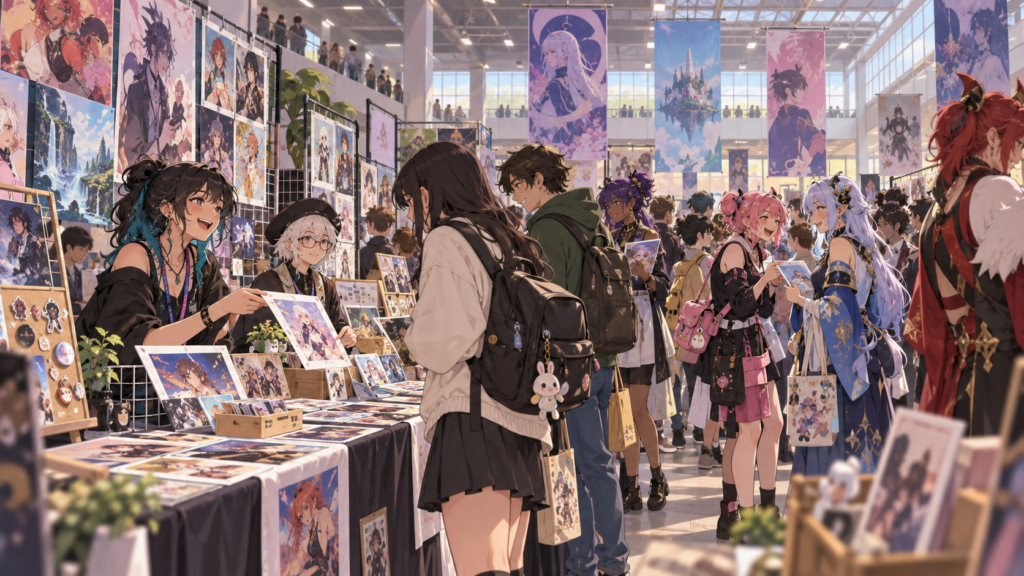
Games, manga, music, and merchandise form an ecosystem
Anime rarely travels alone. A viewer can move from a series to its manga, soundtrack, mobile game, figures, fashion collaboration, or convention panel. Sometimes the path runs backward: a game introduces the characters, and the anime provides the emotional history. A song becomes a global playlist hit and leads listeners to the opening sequence.
This ecosystem gives stories more ways to matter. It also gives fans different levels of participation, from free discussion to serious collecting. The business risk is obvious: success can encourage oversaturation, rushed production, and merchandise that treats the story as an advertisement. Growth is not automatically healthy for creators.
The next challenge is sustainability
The rise of anime should not be measured only by subscriber totals and viewing hours. The people drawing, directing, coloring, translating, acting, composing, and editing these works need schedules and compensation that make long careers possible. Global demand without production reform can turn popularity into pressure.
Platforms also need to preserve discovery. A huge catalog is not useful if recommendation systems push everyone toward the same five titles. Anime became global because fans could find a story that felt unusually personal. The next phase should protect that variety rather than sanding it down.
Why I think the rise will last
Trends fade when they depend on novelty. Anime’s growth is more durable because it now has infrastructure: global platforms, dedicated services, translation pipelines, theatrical distribution, conventions, retail, and multigenerational fandom. A parent who once raced home to watch Dragon Ball Z can now introduce a child to that series and discover a new one beside them.
More importantly, anime offers something modern entertainment often promises but does not always deliver: permission to be sincere. It can be visually extreme and emotionally direct. Characters say that they want to improve, protect someone, belong somewhere, or become worthy of a dream. Even when the premise is impossible, the desire is recognizable.
Anime was never waiting to become universal. It was waiting for universal access. Now that the doors are open, I do not think they are closing.
Sources
- Netflix: 2026 anime audience and viewing figures
- Netflix: global anime fandom and dubbing data
- Sony FY2026 Q1 supplemental information: Crunchyroll subscribers
- Sony 2026 corporate strategy: Crunchyroll library and language reach
- Netflix: global cross-border viewing and accessibility


Responses